

A Letter To Myself….
Journalling isn’t about writing.
It’s about returning to yourself.
A Gentle Way to Return to Yourself
Journalling isn’t really about writing. It’s about returning to yourself.
In a world with so much noise, constantly pulling us to consume, respond and take in more, journalling offers something that feels increasingly rare:
Space.
Space without perfection, pressure or the expectation to achieve anything. Simply a place to be yourself and be with yourself.
That is why journalling can become so much more than putting words on a page. It can feel almost meditative. A conversation with the parts of yourself that rarely get the chance to speak.
Creating Space for What Is Within
We spend so much of our day taking information in.
Social media, work, news, messages, opinions and endless stimuli. Without realising it, we can become very familiar with feeling mentally full, heavy or constantly switched on.
We carry unfinished thoughts and static noise in our systems, with nowhere for any of it to go.
Over time, this can leave us feeling stressed, overstimulated, anxious or disconnected, until that feeling begins to seem normal.
Journalling gives those thoughts somewhere to land.
Research into expressive writing suggests that it may help some people organise their thoughts, process emotions and gain perspective. It is not a cure or a replacement for professional support, but it can create space to notice what is happening within us and make things feel a little less heavy.
Sometimes the most helpful thing is simply no longer carrying everything inside your head.
You Do Not Need to Know What to Write
You do not need a beautiful notebook, perfect handwriting or something profound to say.
You do not even need to know what you are going to write.
Sometimes the most powerful thing you can do is simply put pen to paper and begin.
Try writing:
“Right now, I’m thinking…”
Then let it flow.
When you keep writing, subtle things beneath the surface can begin to reveal themselves. Thoughts you had not consciously noticed. Emotions you had pushed aside. Things that only become clear once you finally give yourself enough space to hear them.
Not every journalling session will lead to a huge revelation.
Some days you may end up somewhere unexpected. Other days you may simply give yourself ten quiet minutes to exhale.
Both matter.
Moving at Your Own Rhythm
So much of life is spent distracting ourselves from what is within.
Modern life does not naturally encourage us to move at our own pace or find our own rhythm. We are pushed towards fast outcomes, instant answers and constant productivity.
Yet almost everything in nature unfolds slowly and in its own time.
Journalling invites us to do the same.
When we sit with a question rather than rushing towards an answer, our thoughts can begin to slow. We create enough space to observe rather than immediately react.
The more aware we become of our thoughts, emotions, beliefs and habitual reactions, the more choice we have in how we respond to life.
Your thoughts are allowed to happen, but they are not the whole of who you are.
Journalling helps us notice the patterns rather than being unconsciously driven by them.
Journalling and Movement
At Concrete Jungle, we believe movement is about much more than what a shape looks like from the outside.
Yoga, strength, dance, somatic movement, breathwork and sound can all create space to notice what is happening within us.
Sometimes we find clarity through stillness. Sometimes we need to sweat, shake, move or breathe before the noise begins to settle.
Journalling can sit beautifully beside these practices.
After a strong yoga or strength class, you might notice where you resisted, where you surprised yourself or what helped you keep going.
After a slower class such as B Soul Drop, Somatic Intuition or Restorative Aerial, you may feel more able to hear the quieter thoughts that everyday life usually drowns out.
After dance, you might write about joy, freedom or what it felt like to move without overthinking.
You do not need to analyse every class. Sometimes it is enough to pause before reaching for your phone and ask:
What am I noticing now?
Movement and journaling are different practices, but both can help us step away from performance and return to our own experience.
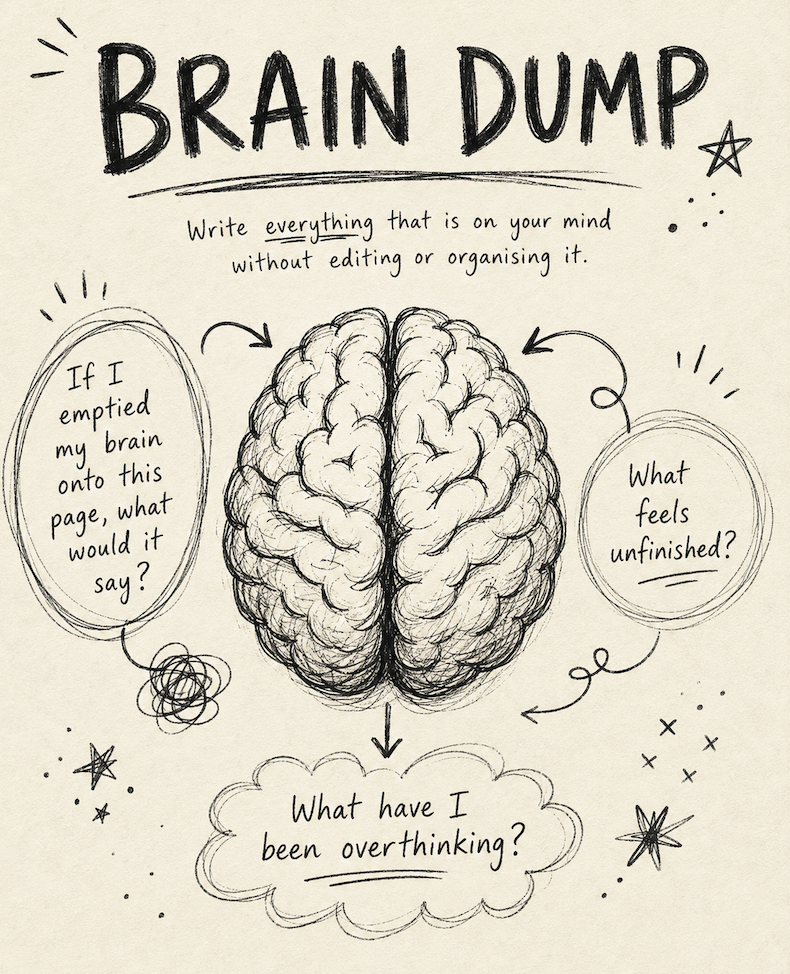
.
Put your pen to paper….
Emotional check in with yourself
(Learn to recognize emotions rather than be consumed by them)
“What am I feeling right now?”
“What am I feeling in my body?”
“What is this emotion trying to tell me?”
Self-Inquiry
(Be curious, not judgmental)
“Why did I react the way I did?”
“What story am I choosing to believe?”
Gratitude
“What made me smile today?”
“What beauty did I notice?”
“What am I grateful for, and why?”
Envision
(Write from possibility, not from limitation)
“If fear didn’t exist, what would I do?”
“What would Future Me thank me for today?”
Write a letter to yourself, from your future yourself experiencing the perfect day.
“What’s an intention I’d like to carry with me?”
Reflection
“What did today/this week teach me?”
“How can I bring more compassion into that relationship or to myself?”
“What would the most honest version of me say about this situation?”
Shadow work
(Explore the parts of yourself you usually avoid)
“What’s been triggering me recently?”
“What’s do I fear, and why?”
Creative
DREAM – get it out of your mind and into the physical!
“What would I create if there were no limitations?”
“What would feel exciting to create?”
Move from identifying with your thoughts to observing them. Your thoughts are allowed to happen, but they’re not who you are, and you begin to notice this when you truly give yourself the space. You see the patterns instead of being unconsciously driven by them. So… in a world that constantly pulls your attention outward, journalling is a path to gently bring yourself home.
Love always, Charlie
X